Strange noises coming from your truck's driveline are never something to ignore. That clunking, grinding, or squealing you hear isn't just annoying. It's your truck telling you something is wrong.
The driveline system is one of the hardest-working assemblies on any heavy-duty vehicle, and when it starts acting up, the consequences can range from a minor repair to a catastrophic roadside failure. Let's break down what's actually going on under that truck.
What Does the Driveline Actually Do?
Before diving into the noise itself, it helps to understand what the driveline is responsible for. Simply put, it transfers power from the engine and transmission to the drive axles, which then push your truck forward. On a heavy-duty vehicle, this system includes the driveshaft, U-joints, CV joints, slip yokes, and related components.
Every one of those parts is under constant stress, especially when you're hauling heavy loads or navigating rough terrain. That's a lot of pressure on a lot of moving pieces, and eventually, something's going to let you know it needs attention.
Common Causes of Driveline Noise
Worn or Failing U-Joints
If you're hearing a clunking sound when accelerating, decelerating, or shifting gears, worn U-joints are often the first suspects. Universal joints allow the driveshaft to flex as the suspension moves and the angle between components changes. Over time, the needle bearings inside the U-joint wear down, lose lubrication, or corrode. When that happens, you'll notice:
- A sharp clunk or thud during acceleration or when shifting from drive to reverse
- A squeaking noise at low speeds that disappears once you pick up speed
- Vibration that gets worse the faster you go
Catching a bad U-joint early saves you from a much bigger headache. A failed U-joint can drop your driveshaft entirely, and trust me, that's not a situation you want to deal with on the highway.
Driveshaft Imbalance or Damage
A damaged or unbalanced driveshaft produces a vibration you'll feel through the cab floor. It often sounds like a low rumble or humming that increases with vehicle speed. Dents, bends, or missing balance weights on the driveshaft are common culprits. Even a thick coating of road debris stuck to the shaft can throw the balance off enough to cause noticeable vibration.
If your truck has recently had undercarriage work done or taken a hard hit from road debris, that's a good place to start your investigation.
Worn Slip Yoke or Splines
The slip yoke connects the driveshaft to the transmission output shaft and allows the length to change as the suspension cycles. When the splines on the slip yoke wear out or run dry of grease, you'll typically hear a clunking or popping noise, especially when pulling away from a stop. Left unchecked, worn splines can cause driveline shudder and eventually lead to complete driveline failure.
Failing CV Joints
On trucks with independent front suspension or certain transfer case configurations, CV joints handle the power transfer at sharper angles. A worn or damaged CV joint usually announces itself with a clicking or popping sound during tight turns. You might also notice grease splatter around the axle boot, indicating the protective boot has torn, and the joint has lost its lubrication.
How to Tell Where the Noise Is Coming From
Diagnosing driveline noise takes a little patience, but there are some reliable ways to narrow it down. Pay close attention to when the noise occurs:
- Noise during acceleration or deceleration points toward U-joints or slip yoke issues
- Noise during turns suggests CV joint problems
- Consistent vibration or humming that increases with speed often indicates driveshaft imbalance or bearing wear
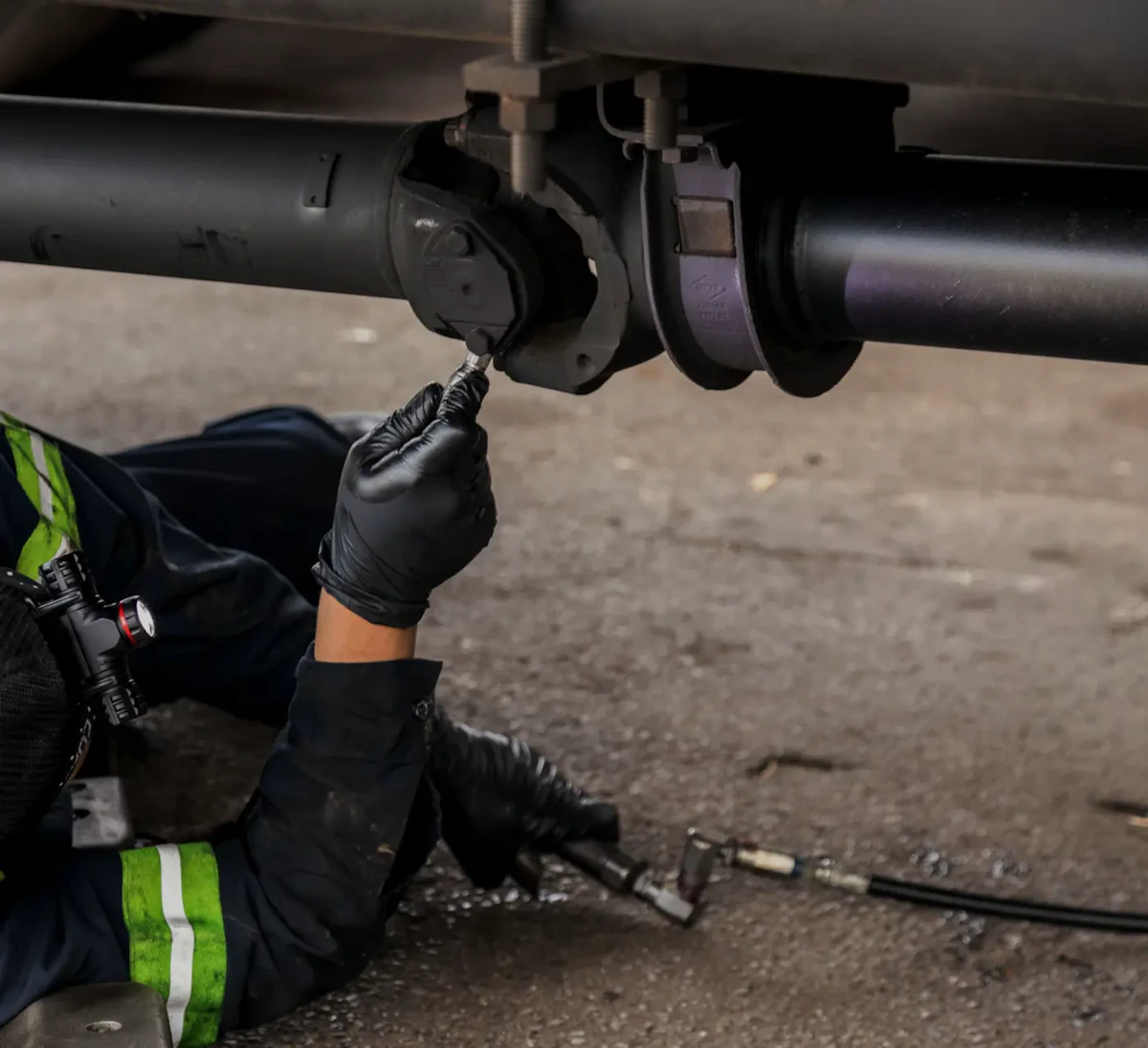
A visual inspection underneath the truck can also reveal a lot. Look for cracked or missing U-joint caps, torn CV boots, excessive play in the driveshaft, and any signs of rust or corrosion around joints and yokes. If you spot grease slung around the driveshaft or axle area, that's a clear sign something has failed.
Why You Shouldn't Put Off Driveline Repairs
Here's the thing about driveline problems: they don't get better on their own. A small amount of play in a U-joint turns into a broken U-joint. A cracked CV boot leads to a seized CV joint. Ignoring these issues doesn't just risk a breakdown; it risks a breakdown. It also puts other components at risk, including your transmission, differential, and axles.
Heavy-duty trucks work hard, and their driveline components take a beating every single day. Routine driveline maintenance, including regular lubrication of U-joints and slip yokes, goes a long way toward preventing these problems before they start.
Most manufacturers recommend inspecting driveline components every 12 months or 25,000 miles, though trucks used in severe-duty applications should be checked more frequently.
What the Fix Usually Looks Like
Repairs to the driveline vary depending on what's failed. Some of the most common fixes include:
- Replacing worn or seized U-joints with new, properly greased components
- Rebalancing or replacing a bent driveshaft
- Repacking or replacing the slip yoke and splines
- Replacing torn CV boots or complete CV joint assemblies
In most cases, catching the problem early means a straightforward repair. Waiting too long often means more parts are involved and the repair cost goes up significantly.
Keep Your Driveline in Fighting Shape
Your truck's driveline is a precision system that deserves to be treated like one. Pay attention to the noises your truck makes, stay on top of routine inspections, and don't brush off vibrations or clunks as "just the way it drives." Those sounds are warning signs, and acting on them quickly keeps your truck on the road where it belongs.
If your truck is making strange noises and you're not sure where to start, the team at Apex Diesel Repair and Parts is ready to help. Bring your truck in for a thorough driveline inspection and get back on the road with confidence.
For more information about truck services, read our article on essential winter maintenance tasks.
%20(1).webp)
%20(1).webp)
.webp)